Donovan here, with a brand new, funky fresh, globetrotting blog! I’m so glad you made it.
My left stroke just went viral…
— Kendrick Lamar
This is the first post on my new blog “Donovan’s Adventures Abroad” I’m just getting this new blog going, so stay tuned for more. I’ll be coming back every week or so with new posts for you all to see! Feel free to share with your friends too. Glad to have you along for the ride.
For those of you who are new, my name is Donovan Carter, and I am a student at Howard University, Class of 2021 and I am beyond excited to start sharing my experiences with you all the way from Cali, Colombia. As you may know–but will soon see– I am studying abroad at Universidad del Valle (Univalle as its locally known) and Universidad Autónoma de Occidente (UAO) studying Race, Ethnicity, and Identity this semester.
What will you see on this blog?
Hopefully lots! I plan on adding things here at least once a week, and I’ll be sharing my experiences, thoughts, and reactions to anything I learn that I find worth teaching you.
You’ll read up on new words I learn, sites I see, and lots of other fun stuff. I can’t wait to share all that I learn with you!
Why should you care?
Because I said so!
Also, because you care about the value a global experience can have on anyone, especially an HBCU student interested in advocacy, justice, equality, and other nice things. I hope you appreciate the perspective I can provide, and I even hope to teach you something.
Check Out my Pre-Departure Video in the link below!
As the school year ends for many in the United States, the education systems and institutions in place would normally celebrate their graduates with grand ceremonies: with pomp and circumstance on repeat, parents and loved ones crying tears of joy, and long yet insightful commencement speeches. I remember graduating high school in 2017, and how it felt to reach that incredibly important milestone. I remember being excited to start my education at Howard, and more than anything, I was excited to make my final exit out of high school. Walking across the stage meant being recognized for the hard work, being celebrated by your loved ones, and stepping into a new chapter of your life.
This year, however, was not a great one for the graduates. The COVID-19 Pandemic has not only cut physical learning for students, but a physical celebration for those who have completed their education. High schools students, undergraduates, and even PhD candidates were not given the opportunity to celebrate an incredible milestone the same way. While this is sad for many students, I can speak to the students whom I know at Historically Black Colleges and Universities (HBCUs) who have had this great moment stripped away from them.
Many HBCUs like my school, Howard University, or others like Tuskegee University, Florida A&M University, or Winston-Salem State University each represent a very unique population of young adults who come from various backgrounds to gain an excellent education. I have many friends who are international students, whose families have sacrificed much to allow their children a better chance. I know many students who are first generation college students, whose academic achievement represents the hopes, dreams, and prayers of those who came before them. COVID-19 took a moment for them to be recognized in a way that represents the effort they put in.
I was very relieved when I saw social media posts and seeing news broadcasts that presented a new opportunity. Many new options emerged: everything from virtual graduation ceremonies put on by different universities, to photo shoots from students in their caps and gowns. While these methods were a bright addition to the otherwise dreary news I was accustomed to seeing, I feel like the students whom I know weren’t receiving their proper recognition. This is when I found the Chase Bank #ShowMeYourWalk challenge.
Social media has always been a powerful force among the youth. It allows for exposure of small businesses, brings to light unheard stories, and provides a voice to those once without one. The #ShowMeYourWalk challenge specifically congratulated HBCU graduates with special guests as speakers, students being recognized, and of course, lots of pictures. What I loved most about the virtual ceremony was the unity shown by Black celebrities to congratulate HBCU students on their accomplishment, and encourage them to continue in their growth and development. Steve Harvey, Serena Williams, Kevin Hart, and even President Barack Obama gave shout outs to the schools, students, and educators that made the dream of our ancestors possible. So while the COVID-19 pandemic took away a traditional ceremony, what it allowed for is an opportunity to show even greater unity.
A recent project my family has been working on together is the maintenance and upkeep of our lawn. We have been working on a few different areas doing different things to bring a little more life to our yard. We’ve done plenty of small beautification projects like add mulch to the flowerbed in front of our porch, we’ve pulled weeds and poison ivy from our backyard, and my mother has even planted some tomatoes and peppers in pots on our deck. Most recently, however, we have been working on our front lawn, adding topsoil and new grass to parts of it that were dead. As I was tilling and digging soil, shoveling gravel, and shaping the earth a thought–more so a feeling– entered my mind. That feeling was a passion in restoration. Restoring the land is a great practice, not only because it helps preserve the lives that live upon it, but also because it both ensures the land’s longevity and creates, if not deepens, the relationship we have with the land.
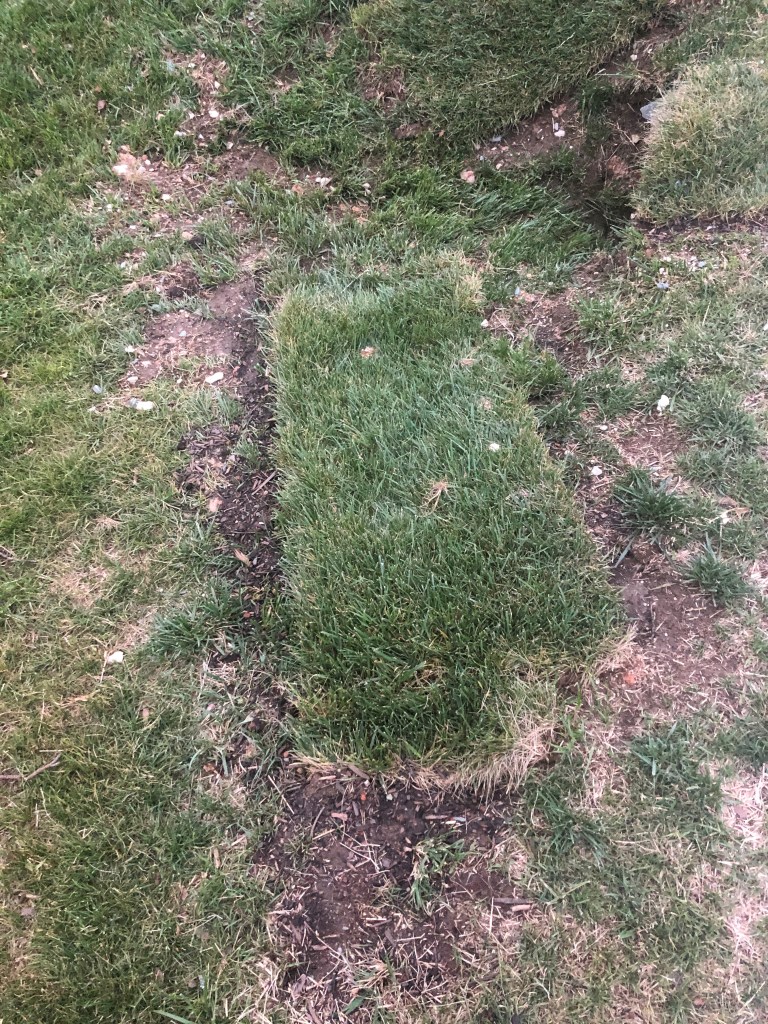
This is a patch of sod I placed. Admire the excellent work on the corners and edges. 🙂
This idea of having a relationship with land is not uncommon. There are families, mine included, who have ownership over an area of land that they plan to keep. It is a resource coveted by developers, real estate brokers, and even governments. Land, for many, means power– and gaining that power means gaining control over land.
I bring this to your attention, dear reader, because land restoration and reclamation have been areas of study for me as of late. The acclimation of land, and thus power, I mentioned before is not limited to the United States, nor to developers, brokers, or governments. In Colombia, land is coveted by drug traffickers, paramilitaries, and armed guerilla groups. Colombia’s internal armed conflict has impacted millions of citizens. The history of violence, displacement, and destruction has claimed the lives of many, and broken the connection between people and their ancestral lands. It is a modern tragedy, and the group disproportionately affected by this displacement is Afro-Colommbians.
The forced exodus of the millions removed from their homes, their histories, and their communities has been a very prominent topic in my courses and discussions. The displacement of Black bodies is not at all a historical anomaly, but Law 70 of 1993 is nothing short of a milestone. Law 70 is basically government legislation guaranteeing land rights, protections, and collective property specifically to Black Communities in Colombia’s Pacific coastal region.
Pretty impressive, right? The Law, though it has its issues (especially with it’s lack of enforcement and fair oversight, something I’m learning in my classes now), it shows that there are efforts being made to make some modern form of reparations. In theory, this Law can begin to mend the broken relationship between the land and those who have once occupied it. Restoration of the land and an opportunity to create history have been made possible. I have enjoyed the privilege of beautifying the land I live upon, and in that action I stand in solidarity with Afro-Colombians are now fighting to retake theirs. While I pull weeds, to make my mother’s flower garden look good, there are those pulling out coca plants from their farms so they can have a second chance at a fair and happy life. I wanted to share this with you all because it struck me very sharply while I was working, and I always like to think further on the things I am learning as I apply them to my life in the States. Thanks for reading!
Things here have gotten better. I’ve finally found a groove that works for me and for the last week or so it has really settled in. From the time I leave my bed in the morning till I return to it in the evening I try to spend my time effectively, productively, and not always too seriously. It seems I am finally getting a grip on this whole online learning thing, and with that comes a stronger confidence in myself. Confidence to work towards some of my other goals, goals like studying for the graduate school admissions tests like the GRE or the LSAT or preparing to apply for scholarships and fellowships, even health and wellness goals like ensuring daily exercise and skin care. I still spend my days intentionally interacting with my family, and I surprisingly haven’t grown tired of them yet (Let’s hope it stays that way).
Now, all of this schoolwork and studying and exercise isn’t done in one go. In fact, I often space these tasks out with small breaks where I may clean, read, or play video-games. Most often, it is the latter. Gaming has always held a special place in my heart, and while I was abroad I really didn’t get to play often. Naturally my skills declined drastically, and it has been a lot of fun re-building those skills. One game I have had a lot of fun playing is the battle royal, Apex Legends. While the game-play is exciting and fast paced, the aspect I love most about it is the team-based combat. In “the Arena”, the fictional coliseum where the battle takes place, teamwork really makes the dream work, and communication can make all the difference between victory and defeat.
What exactly does this video game have to do with your study abroad (albeit from home) experience? you may be asking. Well, dear reader, in the aforementioned communitcation element I mentioned earlier, I was able to revive a nearly dead skill of mine– Spanish conversation.
“Hola, hola… tiene audio o que?” I almost couldn’t believe it. Like many online multiplayer games, Apex has a chat function where players can communicate via microphone to each other. I was used to encountering other players with microphones, but rarely, if ever, would I encounter native Spanish speakers. “Hola?” the voice asked again. “Hola, estoy aqui.” I replied. Shortly after we loaded into the game, my mind started to connect two things I enjoy dearly, video games and the Spanish language. As the game went on, I realized that I was quickly translating words I use almost exclusively for the game, words like “shield/ el escudo” or “helmet/ el casco” or “syringe/ la jiringa” as if I used them in regular conversation. I could give instructions on positioning or directions to enemy hideouts. It was something I never really thought I would do consciously, game in Spanish, but it proved to be much easier, and far more fun than I ever could have imagined. Though we didn’t win, we were very far from victory, I’m sure after a few more practice runs, we’ll get our communication and teamwork ironed out, and we’ll conquer the arena. Ready to game on.
In my last blog post, I mentioned accepting the challenge to remain encouraged despite these trying and uncertain times. While I have been remaining optimistic by keeping myself busy with schoolwork, with reading, playing video-games and other hobbies, the greatest obstacle to face for many of us may be the feelings of loneliness, boredom, and ultimately stagnation.
Loneliness has a funny habit of appearing at the strangest times. I know that I can feel lonely, even when my home has incredibly loving and open people. I think being in the same place all day of every day gives an illusion of solitude, as the experiences that make each day distinct slowly fade away. While I have only been home for about three weeks, it feels like I have been home for three months. Each day feels like a copy of the last day, and a copy of that copy. Combating that lonely feeling, however, requires being intentional in your interactions. When I share things or learn from the people in my house, I feel much more connected.
Boredom is it’s own monster. Much like loneliness, boredom appears at the strangest times. I am never bored after completing all of my tasks, or during a time when there isn’t much to do. In fact, I have noted the opposite: I am most bored when there are plenty of things to do. I could cook something, or read another chapter, or play a card game, or clean my room–but none of the options excite me. In fact, they become a pattern of distractions that disguise themselves as stimulation. It becomes easier and easier to shut off my brain, and go into autopilot– a state of completing common tasks without much thought, much effort, or much–if any at all–emotion or feeling.
When boredom festers and grows, it morphs into something else. What was once no more than a lack of simulation instead becomes a sensation of paralysis. There are many times where I feel stagnant. I feel stuck in a loop of days that don’t lead anywhere, I sometimes can’t tell the difference between what is “today” and “yesterday”.
It is easy to feel stuck in this pattern, especially when my adventures to go out of the house are so few and far between (only for essentials, I promise). What helps me get out of this pattern is being incredibly attentive. Attentive to the details of each day of each hour, and occasionally each moment. This could be planning the things I wear, learn new things to cook and eat, and carefully going over the things I learn in my classes. While my learning and living environment remain very static, I have to keep my mind engaged and dynamic. I have to turn the prison of solitude into a fortress.
Being home has had its challenges, especially in terms of my studies. It has been hard to focus during online classes, it has been hard to manage time effectively, and it is becoming even harder to stay consistent with my Spanish language skills (nadie en mi familia entiende ningun palabra de español). Yet despite these challenges, remote learning does present some interesting opportunities for growth. It forces me to be more introspective, and thoughtful about different ways to enhance my education. Though I am still struggling with finding a routine, there are times when I can gather myself to reach a goal. Sometimes, that goal is as simple as cleaning my room or reading a portion of an assignment, but other times, these goals can help me reflect on what I have learned abroad and give me the chance to teach those closest to me.
There is no better example than me teaching– or attempting to teach– my parents the basic steps of salsa. I put on a couple of songs, and show my father. My mother, in classic Mom fashion, pulls out her phone to record. Soon after, I reluctantly started to show her the steps, and soon after that, we were both smiling. What I thought would be another chore ended up being a lot of fun.
This impromptu instruction got me thinking about more ways I can bring home what I learned, and how that would pay proper honor to my time there. I now think of the card games I learned from my roommates and other students, and the songs they showed me. I think of converting the challenge of being home into an opportunity to teach those closest to me. Maybe teaching, be it dance moves, card games, and maybe just storytelling will help me become a better, more efficient home student. Without being reminded of what I learned while abroad, it is very easy to be discouraged.
That challenge, to remain encouraged, can be daunting, especially when you have much more time on your hands, and nowhere to go and spend it. I know I can only spend so much time reading from my computer screen, or staring longingly out of my window towards the warm Carolina skies without going crazy. And though my studies are demanding and incredibly interesting, this transition to online courses time has taken some joy out of learning.
In order to find that joy again, I think I will spend a lot more time reaching out to my roommates, the friends I made there, and even my professors. This tine of isolation has a funny habit of making us feel alone in our solitude, yet we must be vigilant. We are all in this together, and we can’t ever forget that.
Then be an advocate, tell your homies especially/ To come back home
Kendrick Lamar- Momma
Things have changed incredibly quickly within the last seven days. For starters, I am no longer in the beautiful Cali, Valle del Cauca, Colombia. The COVID-19 outbreak has spread its claws all around the world, and though Colombia was late to catch the wave it was no different. My home institution, Howard University, switched over to online classes, Colombia closed her borders, and soon a shelter in place order would be sent out. Tuesday March 17, we learned our program would cancel, and classes would continue in an online format from our homes. Not at all how I imagined my study abroad experience going, but I have learned so much despite my experience being cut short.
I, along with many other study abroad students effected by the pandemic have joined our stateside peers from our home universities, and have been sent home. Home, however, is very different from how I remember. After spending Friday and Saturday March 20 and 21 travelling, sleeping, and travelling again, I thought somehow that America would feel like home again. What I have found instead is something much more hollow.
The United States has a heavier air than Colombia. The tone is more serious in ways, and the panic has definitely seeped in. Colombia, and Cali specifically, had not nearly reached the level of fear I was seeing in the States. I could see why my mother was worried. Colombia seemed distant and safe, as it was. The risk was lower, and there weren’t news outlets giving so much airtime to fearful statistics. There was still a sense of preparedness and urgency, especially towards my final days in Cali. In the US, however, the threat is treated as a reactionary measure, rather than proactively. This was no more clear than on my journey from Cali to Charlotte.
My Avianca flight from Cali to Bogota was relatively normal. There were few empty seats, there were crying babies, and of course like a modern fashion statement, there were few passengers wearing masks. El Dorado Airport in Bogota was nearly dead. There was a disturbing stillness, an emptiness that seemed unreal. What grounded me and brought me back to reality, however, was the woman who took my temperature shortly after landing. Before entering the transfer terminal, everyone was subjected to a quick temperature scan, and were questioned about any symptoms. This would signal the shift from a local exclusion I felt from the virus into a global panic. Though I was supposed to, I didn’t feel more safe.
This pattern continued the more places I went. From Bogota, I flew to Houston, and from Houston to Dallas, and from Dallas to Charlotte. Each step closer to home felt like a step further into the belly of the beast. Announcements in the airport PA systems, the emptiness of restaurants and the increase in masked wearing strangers further distanced me from any sense of reality or security. I once again felt a sentiment that I explained to my Colombian peers, a feeling of constriction.
Arriving at my house was still warm, still cozy, still homey. I couldn’t help but shake the feeling, however, that the world around the bubble of my home had changed, and not necessarily for the better.
Going abroad is an incredible opportunity. It can teach you about the world and your place in it. It can show you more things than you ever think you’d be ever to learn. One of its most important lessons, is that of managing finances. Travelling to a foreign country definitely presents many new and interesting ways to spend your money, and it is waaayyy easier to blow cash than you may wish it to be. This is especially true in Colombia. Fortunately, I have some tips on how you can save up while you’re here!
There are a few things to know before you come to Colombia. First, keep in mind that Colombia has a very cash heavy society, nearly everything from restaurants to ride sharing apps are paid in cash, and you shouldn’t expect to pay for things with card as often as in the States. It is best to come into the country with a good amount of Pesos already acquired, that way you won’t be caught off guard upon arrival. What helps me a lot is pulling a lot of cash from an ATM, and budgeting that for two- two and a half weeks.
Secondly, Pesos are counted and spent by the thousands. I know what you may be thinking, and yes, it is very easy to have a million Pesos, BUT this does not mean you can live like a millionaire. The way the Colombian Peso is priced, it functions more as a cent. I say this meaning that things will cost thousands of Pesos very regularly, like how things costs hundreds of cents (dollars). This spending method translates into the currency itself, as you can see below.
The bills represent the number of thousand ,mil, pesos while coins represent 100, 200, 500, and 1,000 pesos.
Thirdly, keep the exchange rate in mind at all times. As of today, March 15, 2020, 1 U.S Dollar is exchanged to 4028.39 Colombian Pesos. Not good at math? No problem! Simply take off the thousand, and divide the price you see by four. For example, something may cost around 60,000 Pesos, and while that may seem like a lot, dividing 60 by 4 will get you around 15 US Dollars. It is important to keep this in mind because you will have very large numbers on your receipts, but hopefully the quick conversion helps you keep your cool.
Finally, I want to give my last piece of advice– PACING! It is very important to budget and stick to it. a cash heavy lifestyle can be very good for budgeting. One thing that helps me is keeping a certain amount of money and stretching it for two or three days. It is very, very easy to spend cash on things you don’t necessarily need, or just because it is a good price compared to the U.S. Don’t do that. Keep these tips in mind as you make you plans to travel to lovely Cali!
Somebody shoulda told me it would be like this, be like this, be like this
J. Cole- False Prophets
Being abroad, especially for a long time, is a lot like going off to college. I am very far from home, very out of my element, and tasked with the seemingly impossible challenge of finding success. Unlike going off to college for the first time, I have had practice. I’m used to being away from my parents and family, I’ve grown comfortable with being uncomfortable, and I made it out here for 21 years, and counting. This ain’t my first rodeo, so I should be fine… right?
Turns out, I’m gonna make it! Like I said, this ain’t my first rodeo. It is rather my first rodeo on “hard mode”. I have fewer safety nets, less free time to take breaks(hence the gap in these blog posts), and fewer instructions. Being out here– like being at Howard– has shown me the importance of mastering one very crucial skill: freestyling.
Freestyling: The art of creating solutions to problems as they come. Going with the flow.
Freestyling has reminds me that I don’t have to be completely in control to feel secure, and that the illusion of control is a shackle. A shackle to routine, a shackle to patterns and habits, and a shackle to fear. I freestyle nearly every day with lots of challenges I face, from changing plans around Caleño traffic patterns, to freestyling dinner. Freestyling has taught me how to be a better adult, and helps me be more open and flexible to what life throws at me.
Life has thrown me a lot here, and slowly but surely, I am adjusting. Though the safety nets aren’t there to fall back on, I have found myself quite capable without them. The training wheels are off. For the first time in a very long time, I am completely independent, and with this independence comes a learning curve. Learning how to live with women as roommates, learning how to shop effectively and balance a budget, and especially attempting to learn how to cook have proved challenging at times, yet at other times they prove to teach me so much about myself. There is very little room for doubt when you’re hungry after a long day of classes, salsa, and running errands. There is only room for ingenuity and creativeness– and out of that creativity came this dinner.
Cooking, just like other skills, develops over time, and I was incredibly proud of myself for making something small work. I felt like a real adult. This was when I realised that Adulting isn’t having everything planned out, or knowing what you’re doing(Though those things help). In fact, you could say it is the opposite. Adulting is not knowing how to balance your time and figuring it out. Adulting is branching out of your comfort zone and hanging out with locals. Adulting, despite what I may have thought when I was younger, is incredibly scary–but that’s what makes it fun.
I’m putting my heart and my soul in this [here] and some more.
Future
We are a little over halfway through Black History Month here in Cali. Even though they celebrate Afro-Colombian Heritage in May, I have very much gotten into my “I’m rooting for everybody Black” bag. This week I’ve felt incredible pride for my heritage. It felt like everything I did, from listening to the While Black podcasts with my morning showers, to wearing a dashiki to class was done with the Diaspora in mind. One of the most important things I’ve learned at Howard is the vastness of the Diaspora, and being here has not only put it into perspective, but also allowed me to think of my place in it. This is a result of the incredible critical thinking I have been exposed to, and the constant dialogues I’m having on what Blackness looks like here. As I reflect on the month I have been here, I find it difficult to quantify how much I have already learned, but what I can try to express is how incredible the growth feels.
While it is no secret that Black History, nor its celebration, are not limited to February, the While Black podcast introduced a new concept to me. February is a time where we not only reflect on Black History, but also pour into the things that will secure a greater future for the Black Diaspora. It is a time for thinking about how you can contribute to the fight our ancestors began, and how you can use your gifts to ensure their dream comes to pass. February evolves from Black History month to Black Future Month.
This idea came to me at seemingly perfect timing, for last week, starting February 10, my CET classes began. Each of these courses has a focus on Afro-Colombian experiences, histories, contributions, or culture. I was incredibly excited to start learning about Crime and Justice in Colombia from a brilliant Afro-Colombian attorney, and delve into environmental conflicts with a well published expert. Each class has something incredible to offer, and each will teach me so much more about the Diaspora from the Colombian context. There have been few times where I have been so excited for classes to START rather than end, and this week’s CET classes take the cake. I am incredibly excited to equip myself with knowledge and thinking that will make an impact.
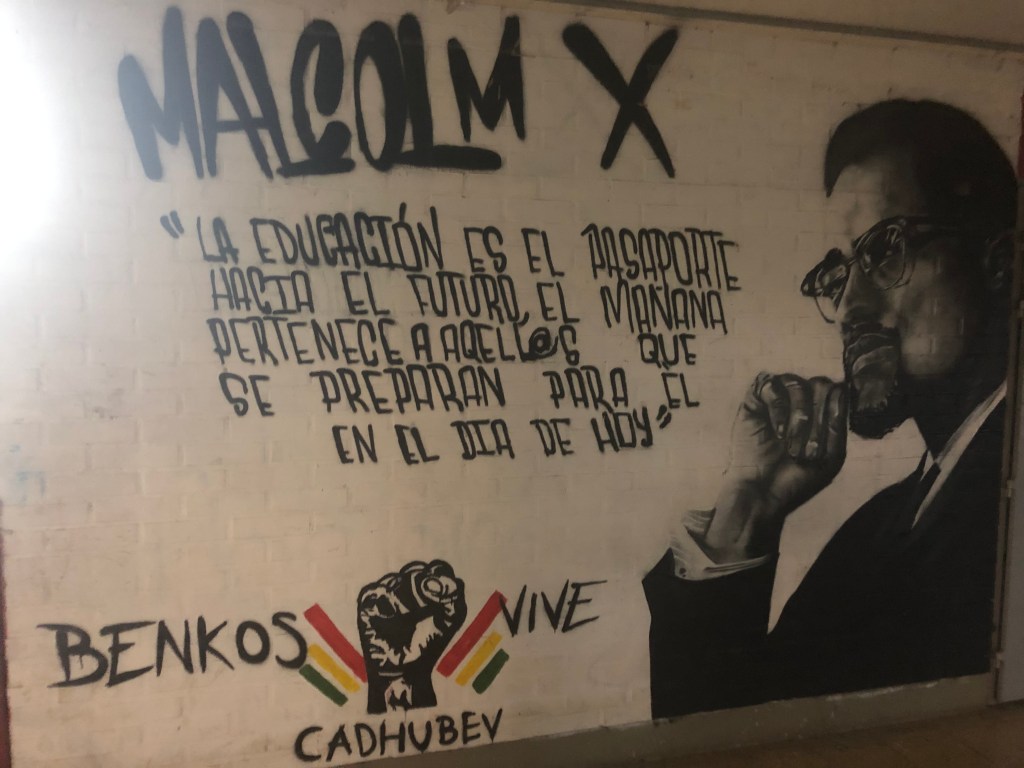
Black Future Month was fully realized for me after my classes ended. On Saturday, February 15 I was inspired to pour into others. CADHUBEV, which stands for Colombianos Afrodecendientes por Derechos Humanos Benkos Vive, is a very active group on campus. They’re responsible for representing the Black population on Univalle’s campus, hosting discussions and events, and even painting dope murals like this one.
CADHUBEV’s first reunión, or meeting, of the year took place in an small lecture hall with a little over 100 young Black students. What made this meeting so incredible was the fact that nearly all of them were local high school students and graduates, and that one of CADHUBEV’s founders Marcos Salazar, was able to talk to them about what Univalle has to offer. Salazar began his speech by encouraging not only the youth in attendance, but the older, Univalle students as well. He gave us all a charge to challenge what others think of Black students, and even what we may think about ourselves. As he told the youth to read more, to push beyond their perceived limits and to remember the fight our ancestors started, I felt renewed. As the meeting ended, I started chatting with the high school kids, many of which had never thought seriously about college. One student asked if college was hard, while another asked if I ever missed home. Both of these, I told them, are true, yet the college experienced provides more than you could ever imagine. This was an incredible wrap-up for this week because despite my different experiences, my different background, and even a language barrier, we shared a dialogue of encouragement, of perspective, and of the future. We talked about what we liked to learn, and how great it feels to be successful academically. I pored into the next generation of leaders. I directly contributed to Black Future Month, and I challenge you all to do the same.
Cali, Colombia is the world capital of Salsa, a distinct style of Latin American music and dance. In the city it’s no secret at all. The sound of salsa can be heard all over the radio, pouring out of homes in the streets, and echoing from dance clubs in the evening. Salsa from Cali, or Salsa Caleño, has its own special flavors that make it so much fun to dance to.
Salsa Caleño is known for its speed, and boy does it fly. It has lots of energy, which can be seen by both partners moving their feet very quickly. When the energy is really high, sometimes partners will toss each other into the air for a somersault! Muy Chevre. As you’ve probably guessed, I am nowhere near that level.
Dancing has never been a strongsuit of mine, so I try and save myself the embarrasment by ommiting myself from the dance floor. In Cali, I’ve decided to have as much fun as possible without stepping on my partner’s feet. As of today, I have gone out to dance salsa a total of three(3) times. Each time has taught me something new, exciting, and fun.
We first went dancing at La Topa Tolondra, or La Topa. This salsa club is incredibly lively. It has a massive dance floor, great music, and a welcoming atmosphere. At La Topa, I became familiar with the very basic steps of salsa. Salsa isn’t much different from a two-step, but it moves in three, and you only extend one foot at a time.
Two-Step: An incredibly simple dance that you’ll probably see your dad do at the cookout. Rocking and stepping side to side with the beat.
Salsa at La Topa taught me to get out of my comfort zone and dance, despite not knowing the steps. Often times, finding a partner to dance with is pretty simple, and they’re usually friendly, too. It’s okay to let your partner know that you’re new to salsa, especially if you’re leading the dance. Be open and flexible to changing up the steps, the last thing you want is an unhappy partner. The last thing they want is you stepping on their toes, so don’t get too wild. Remember to end the song with a vuelta, or turn, and a thank you.
Nearly a week later, I went to La Mala Maña Salsa Bar. Same great music and atmosphere, but with a tighter dance floor. Here, the songs were a bit faster, so it was great having some experience beforehand. Even though I was still new to salsa, I was able to show the basics to another exchange student. I was able to see how much more comfortable I was, and I stopped worrying. I relaxed, fell in the pocket of the music, and danced salsa.
The third time I went out, we did a lot more than salsa. We went to a rumba class at Elite, where we learned the basic steps to salsa, bachata, merengue, and other Latin American dances. Elite is a dance studio, most known for its classes and world-class performers. Here, unlike the other times, I went dancing, I had a mirror. For the first time, I could see myself–and boy was it bad. I was offbeat, I couldn’t move my hips very well, and I would trip over my own feet. Despite my embarrasment, I pursued, and eventually I got it.
Dancing salsa–albeit poorly–has taught me a couple things. First, its really okay if you can’t dance, just try and have a good time. Secondly, don’t step on your partner’s feet, they really, really hate that.